
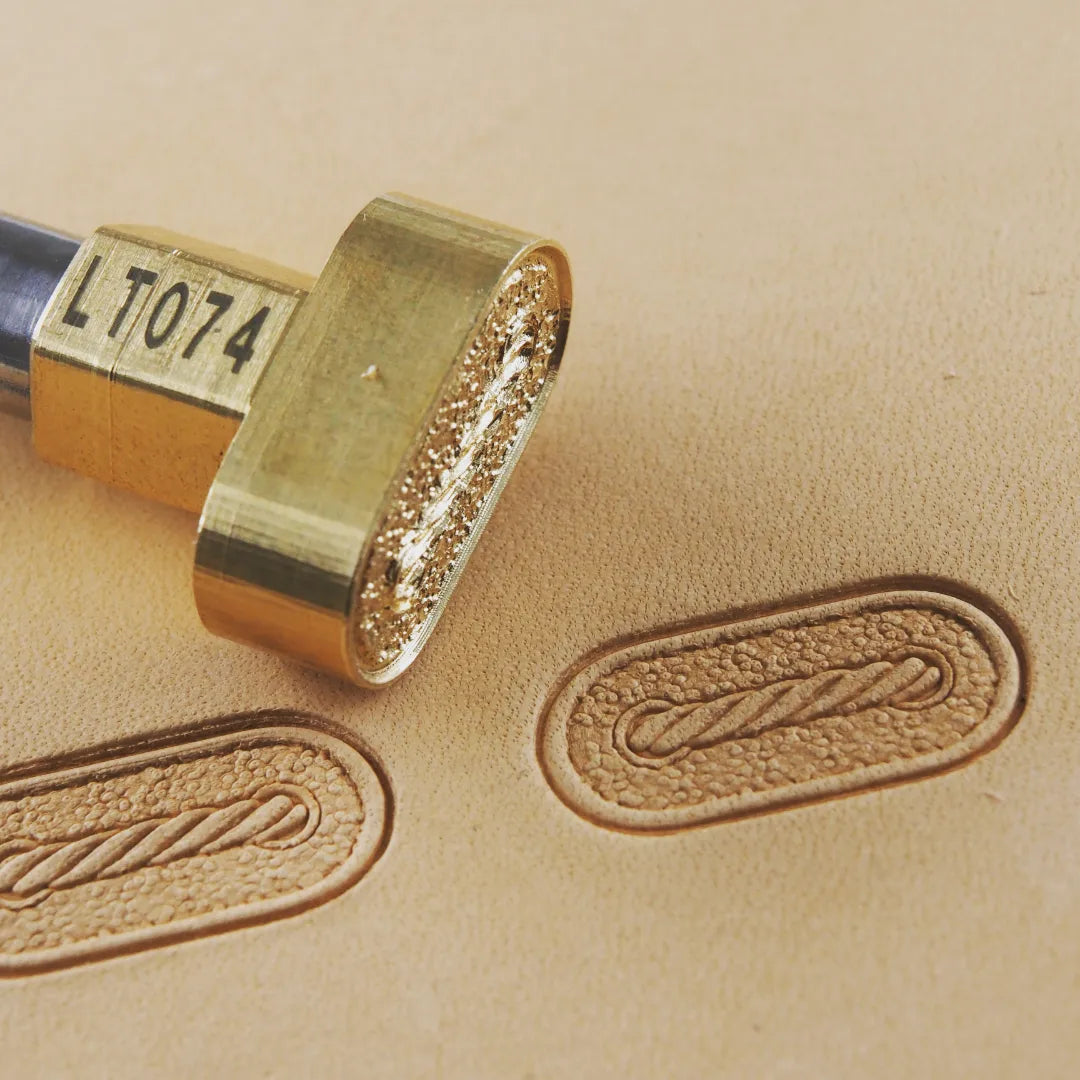
If you have stamped vegetable-tanned leather with a cheap cast tool and a good milled one on the same day, you already know the answer. This is the explanation of why.
The material matters less than how it is cut
Brass gets the credit, but most of what people notice is not really the metal — it is the manufacturing. A stamp head is either cast in a mould or milled from solid stock, and that decision is what shows up in your leather.
Casting reproduces a shape by pouring metal into a mould. It is fast and cheap per unit, and it is genuinely fine for bold designs. But molten metal does not perfectly fill the sharpest internal corners of a mould, and every generation taken from a master softens a little more. The first casualty is always the finest detail: the crossing point of an interlace, the veining in a leaf, the serif on a letter.
Milling removes material from a solid bar with a rotating cutter. Nothing is being reproduced from a mould, so nothing degrades between one stamp and the next. The limit is the diameter of the smallest cutter, not the behaviour of a liquid. That is why we cut every stamp from solid brass in our workshop in Novi Sad rather than moulding it, and why fine Celtic interlace and leaf veining still read clearly after hundreds of strikes.
Why brass specifically, and not steel
Three practical reasons, in the order they will affect you.
It does not rust. This sounds minor and is not. Leather must be cased — dampened — before it will take an impression, so the face of your stamp is wet every single time you use it. A steel head left on a bench after a session will show it. Brass will not.
It machines cleanly. Brass cuts with very little tearing at the edges, which is exactly what you want when the whole value of the tool is a crisp boundary between struck and unstruck leather. Harder steels fight the cutter and the finish suffers.
It is soft enough to be safe on leather and hard enough to last. Brass is a working compromise, not a luxury. The handle is a different job, which is why ours is stainless steel — it takes the hammer, so it should be hard.
Do not heat your stamp
This is worth stating plainly because the advice circulates and it is wrong for this kind of work. Leather stamping is a cold, wet process. The impression comes from cased leather compressing under a struck tool, not from heat.
Heat belongs to a different craft — branding irons and foil stamping, where you are burning or bonding rather than compressing. Apply heat to damp veg-tan and you will scorch and stiffen the surface, and you will lose the burnished sheen that makes a good impression look deep. If your impressions are shallow, the answer is almost always casing or strike technique, never temperature.
What actually makes an impression crisp
Assuming the tool is good, four things are in your control:
- Casing. Damp, not wet. Wet the leather and let it sit until the surface returns to close to its natural colour and feels cool rather than slick. Too wet and the fibres mush and the detail closes up as it dries.
- One strike, square. Rocking the tool between blows is the single most common cause of a blurred impression — far more common than insufficient force. Hold the handle vertical and commit.
- A solid surface underneath. A granite or marble slab under your work. A wooden bench absorbs the blow and you will compensate by hitting harder, which distorts the leather.
- Enough leather. Veg-tan of roughly 3mm and up gives the fibres somewhere to compress into. Thin leather bottoms out and the back of the piece deforms.
A deeper die needs a more committed blow than a shallow one, which is why we record a cut depth for each design rather than leaving you to guess.
How to tell a milled stamp from a cast one
Turn it over and look at the face under a light.
- Cast tools tend to show slightly rounded internal corners, a faint seam line where the mould halves met, and a grainier surface in the recesses.
- Milled tools show consistent tooling marks running in the direction of the cutter and internal corners with a small, even radius — the cutter diameter, identical everywhere on the tool.
There is also a deliberate taper on the walls of a well-made die, called a draft angle. It is what lets the stamp release cleanly from the leather instead of dragging fibres up as you lift. A die cut with vertical walls will fight you every strike.
So is brass better?
Brass is the right material, but a cast brass stamp will still disappoint you next to a milled one. Judge the tool by how it is cut, not only by what it is cut from.
Every stamp we sell is milled from solid brass, fitted to a stainless handle, and made to order — you can browse the full range of leather stamping tools, or send us your own artwork for a custom leather stamp.